Some notes on method
We have to start somewhere. How about ‘The mode of production of material life conditions the general process of social, political and intellectual life’ (Marx, 1859/1970, p. 20)? Arbitrary, but makes sense and usually (because it’s Marx) starts a good argument. Sadly, ‘conditions’ is a weak English word. Bedingt is the original. The joyful and Joycean German means, literally, ‘be-things’ (verb: to thing, intensified by the be- prefix). We’re interested in how musical instruments, technologies and systems of distribution and exchange be-thing music to us individually and collectivities of people in general. David Byrne (2012) richly brings together lived experience of the music industry with an interdisciplinarily matrixial method of problem formulation to create unusually generative insights. Yes, we’re starstruck because he had some cool hit records, but by looking at the material be-thingness of musical production and exchange he says something interesting and true. And the conjunction of the two generates a ‘psychic energy’ – Csikszentmihalyi (1990) also talks about flow – that makes Byrne’s book a publishing and intellectual success, a publisher’s scene.
What are the connections, middle terms, relations, mediations, media, affordances, technologies and things-that-are-mittelbar (Marx, 1857–1858), literally ‘middleable’? Here’s a table of a very few:
| Agent | Mittelbar | Receptor | Context |
| production | distribution | consumption | exchange |
| musician | instrument or band | audience | club, sometimes ‘scene’ |
| Albert Ayler 1967 | saxophone | Harlem jazz community at Coltrane’s funeral | grief, loss |
| saxophone ‘look’ 1950 | camera, improvements in film light-sensitivity | media consumers | still looks cool on modern phones and computers |
| Coleman Hawkins 1925 | electric recording/mics | record buyers | record business |
| Abdullahi Qarshe | oud | people of Somali diaspora | longing for community and homeland |
| piano manufacture | musical instrument shops | middle and upper classes | new ways of feeling |
| individual | language | language-group | communication |
| club | money | financial system | ‘we all gotta live’ |
| book | bookshop | readers | publishing |
| student | essay | examiners | university |
Each line is a system. Any term (see club) can appear under different categories depending on its function in another system. No system is discrete. Systems ‘read’ against and with each other, like metaphors. Systems are part of other systems, like a romanesco cauliflower:

Photo 1 Romanesco cauliflower modeling recursivity. Photograph by the author.
We can imagine a Totalität of systems but a cauliflower the size of the universe is epistemologically unwieldy. Perhaps, inspired by Stafford Beer (1981), in combining intellectual adventure and practical utility it is simply and actively helpful to say that systems are analytically recursive and homologous if not (of course) invariant. In what follows, ‘scene’ describes not just a place or social grouping, but a configuration of mediated relations – musical, visual, cognitive, technological and affective. The proof system of the pudding system is in the eating system.
What is a saxophone?
The saxophone is a hybrid brass/woodwind instrument: the tone generator is a single cane reed (Arundo donax) clamped to an originally hardwood mouthpiece – nowadays brass, ebonite or 3-D printed plastic. It has a large bore, expanding at about 1:18 (Baines, 1967, p. 142). Unlike the flute, oboe, clarinet or bassoon, the sheer size of the bore and the distribution of vent holes means that every hole for every size in the family is covered by a leather-covered pad at the end of a key. The keywork is a highly ingenious mechanism that lifts or closes combinations of keys – the player is never directly aware of what is going on – depending on what works best with the physics of the air column. The conical bore overblows the upper register at the octave, simplifying the learning of fingering.
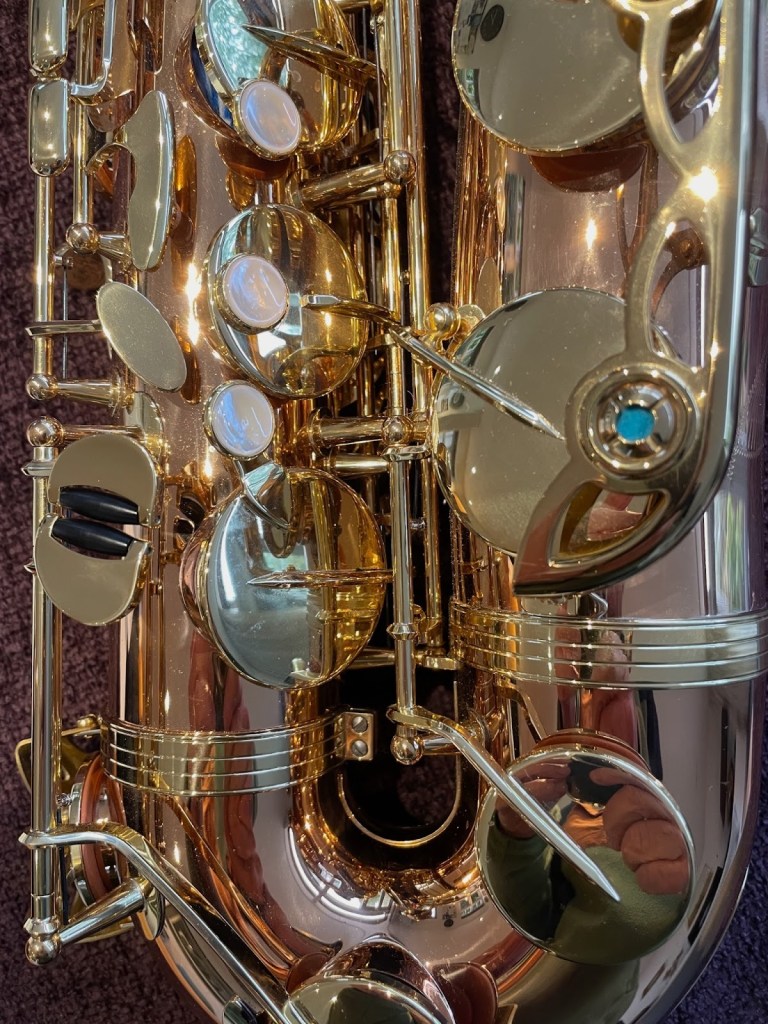
Photo 2 Some steam punk keywork on a 2025 Yanigasawa TRO2 tenor sax, bronze plated. Photograph by the author.
The saxophone sprang fully formed from the head of Antoine-Joseph (Adolphe) Sax in an 1846 Paris patent. It was designed to pump up the volume of the conventional instruments in French military bands. According to Segell (2005, p. 17), one 1840s commentator remarked: ‘Whoever heard an Austrian or Prussian band surely broke into laughter upon hearing a French regimental band’. Seized instruments from retreating Turkish armies, including wailing double-reed shawms and piercing war trumpets, beefed up Prussian soldiers’ morale marching into battle. Approval from King Louis Philippe I speeded up widespread military adoption of Sax’s invention in 1847. Whatever the subsequent fortunes of the monarchy, the manufacture of saxophones remains part of French culture: Coltrane’s Mark VIs were made by Henri Selmer Paris.
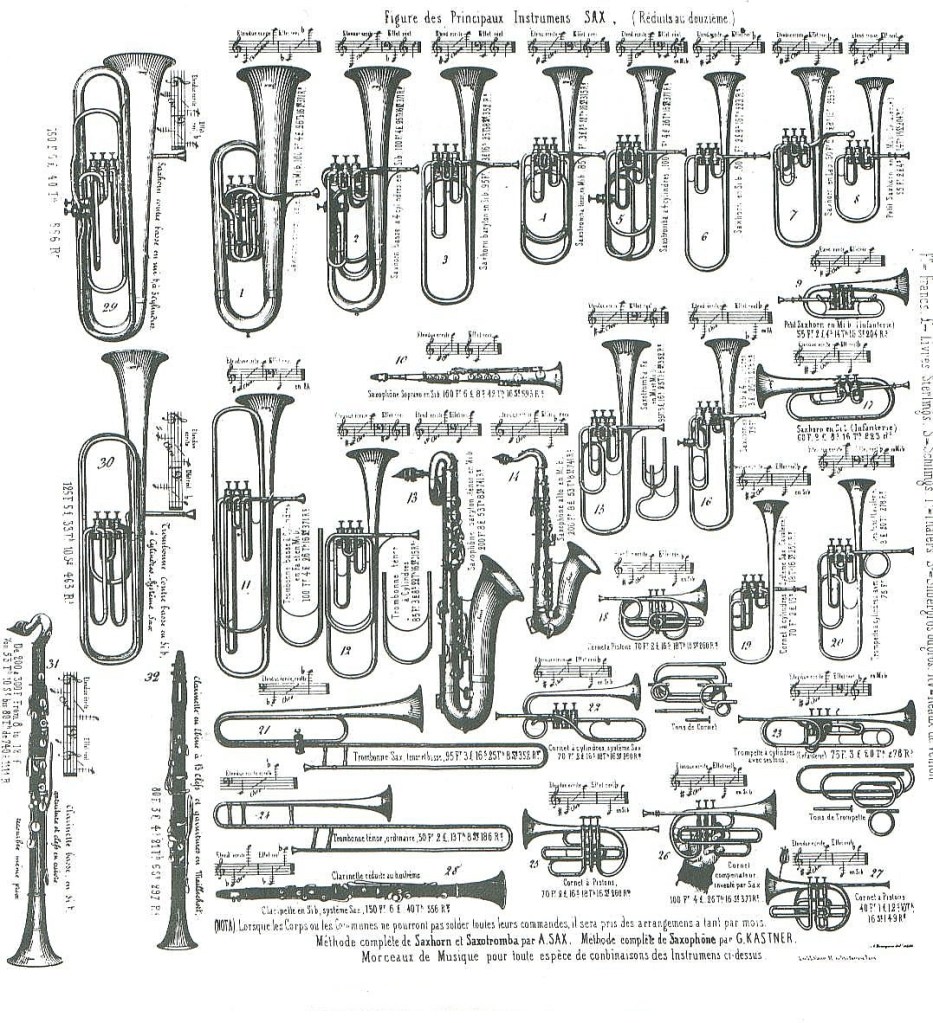
Photo 3 From the Sax company catalogue of his innovative and self-titled instruments (saxhorns and saxotrombas) c. 1850. In the middle are the straight soprano (10), tenor (with swan neck, 14) and baritone (13).
In early New Orleans jazz (c. 1880s–1920s), the core wind instruments were clarinets, trumpets, trombones and low brass – trumpets dominate a live, unamplified soundscape; the sax connection came later.
The saxophone was not part of the classical music scene either. Berlioz (1855): ‘The saxophone is endowed with a rare power of expression … It cries, sighs and dreams. It has a crescendo and can gradually diminuendo until it is only the faintest of sounds …’ – but it remains largely unwanted in the symphonic repertoire.
Both these absences have actually helped clear a space for the sax in popular music. Ted Gioia (2011, p. 104) identifies Coleman Hawkins (1904–1969) as the prime mover of a new conception: ‘Hawkins’s impact extended even more to the sound and fury of the tenor … Prior to Hawkins, the saxophone’s versatility and the absence of role models from classical music were as much a curse as a blessing … Whinnying noises, smears, slap-tonguing, barks, growls, novelty effects … were all part of the shared vocabulary of the pre-Hawkins idiom. But Hawkins forged a streamlined jazz tenor sax sound, one that remained dominant for the next 40 years …’ Compare the living death of the clarinet and trombone – trad jazz glissandi and portamenti were once original and expressive, but the sound now feels flippant and empty.
In Byrne’s terms, new electric recording techniques c. 1925, including close mic-ing (see Millard, 2005), helped the public who played 78rpm records on their (electric) radiogram to newly hear music in depth, detail and with a feeling of intimacy; Hawkins and the scenogenic sax sound were there, ready.
Coleman Hawkins, Body and Soul, 1939
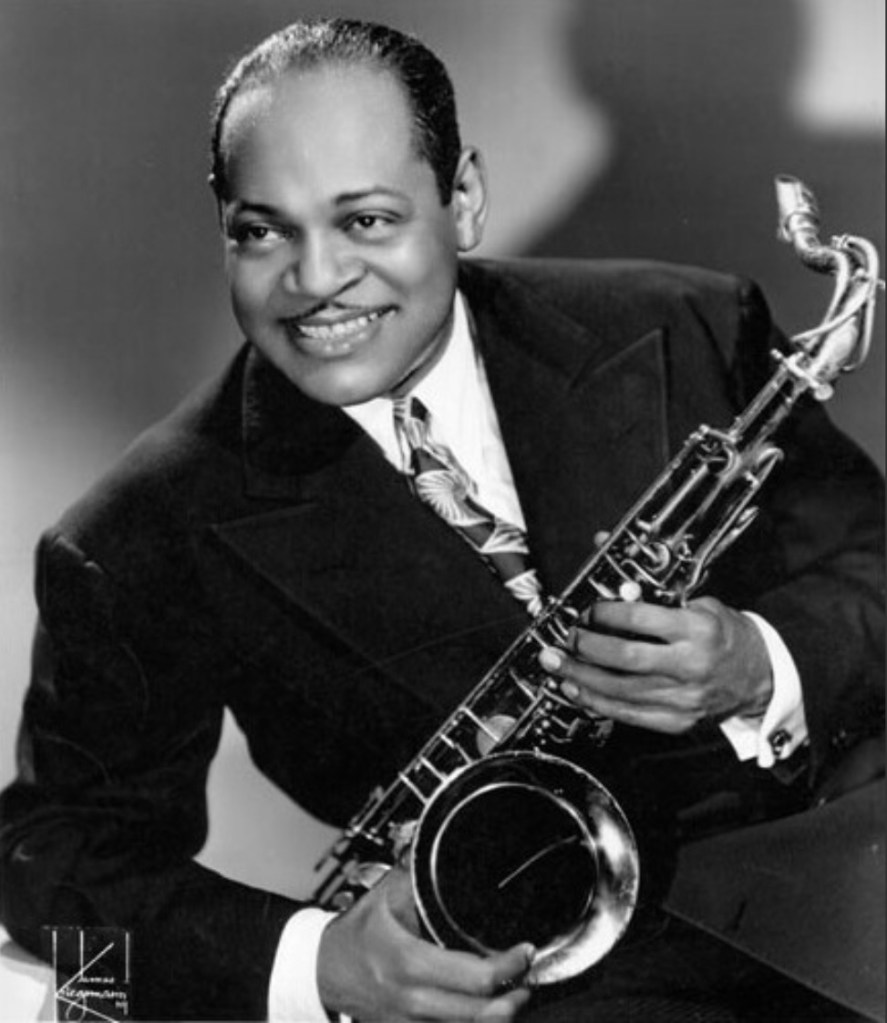
Photo 4 Coleman Hawkins exuding poise and charm in a publicity photo c. 1940. Photographer unknown.
Heard and seen
What is the sax sound? David Munrow (1976, p. 41) talks about ‘the orgiastic tradition of reed instruments which begins with the Greek aulos, used to accompany the dithyramb in the wild rites of Dionysus, and continues with the jazz saxophone.’ Buying a new custom 3-D printed mouthpiece from syos.co used to involve choosing from a list of adjectives. Disappointingly, there wasn’t ‘raunchy’, although the horn, in the right hands (mouth?), can really do raunch. Then there’s a ‘three-o’clock-in-the-morning,-I’ve-had-too-much-to-drink-and-my-baby’s-left-me’ sound – try doing that on the violin. Searing sax solos in rock (for example ‘Careless Whispers’, ‘Baker Street’, ‘Brown Sugar’) heat up/intensify the music’s feeling-range to beyond the limits of language or song. We ‘lose our head’ as the solo racks up the delirium; when we come down, we feel good.
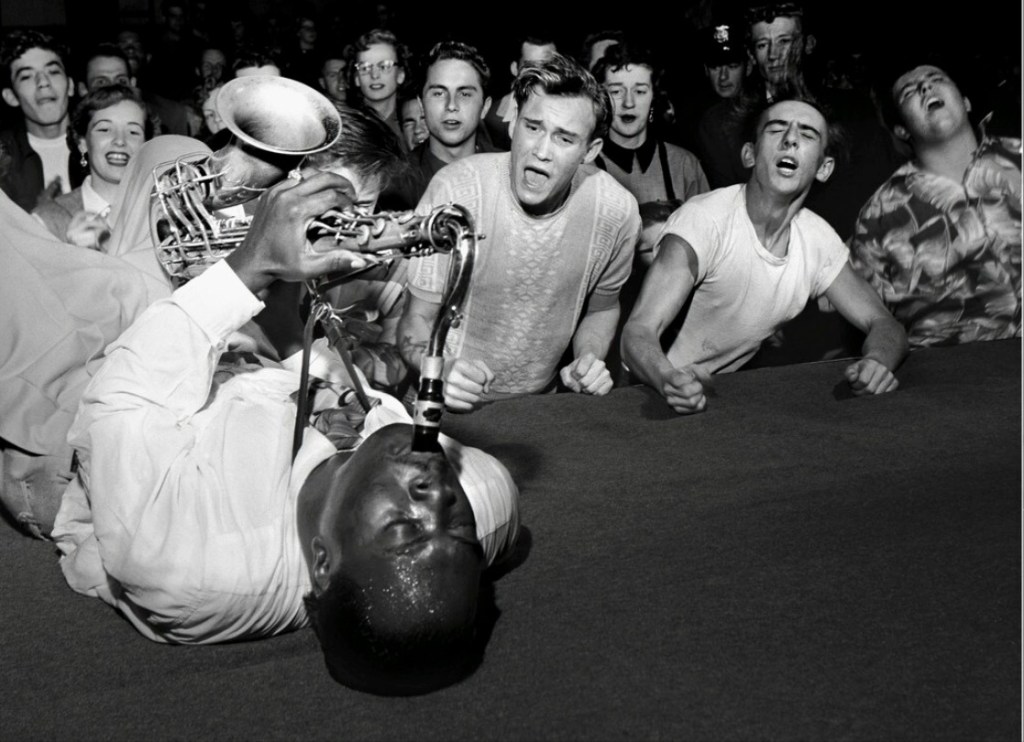
Photo 5 R’n’B player Big Jay McNeely drives the crowd crazy at the Olympic Auditorium, downtown Los Angeles, 1951. If it looks like a scene and smells like a scene … Photograph by Bob Willoughby.
Visually, spotlights bouncing off lacquered brass make the sinuous but hard-edged outlines and machinery of the sax look great in black and white against dark suits and dark skin. Mittelbar convergence with 1950s improvements in light-sensitive film makes for an iconic ‘look’.
John Coltrane: a brief scenography
John Coltrane (1926–1967), like Shakespeare, extended (smashed through) the expressive possibilities of his Mittelbar. From early days a powerful, ‘straight ahead’ player, his propulsive middle period ‘sheets of sound’ (Ira Gitler) technique probably evolved from a typical jazz player’s chromatic arpeggios/inversions practice routines, but expanded by obsessive study of Nicolas Slonimsky’s (1947) Thesaurus of scales and melodic patterns. Slonimsky was an academy-trained conductor and musicologist, a fierce proselytiser for avant-gardists such as Varèse and Ives. With Coltrane this mutates into both an Expressionist sonic vortex (chordal <—> melodic) and a cerebral extension of Parker’s harmonic innovations into further chromaticism (‘Giant Steps’, 1960). Yet at the same time Miles would harness Coltrane’s virtuosity to the minimalist/cool modal jazz concept to make the classic jazz album, Kind of Blue (1959).
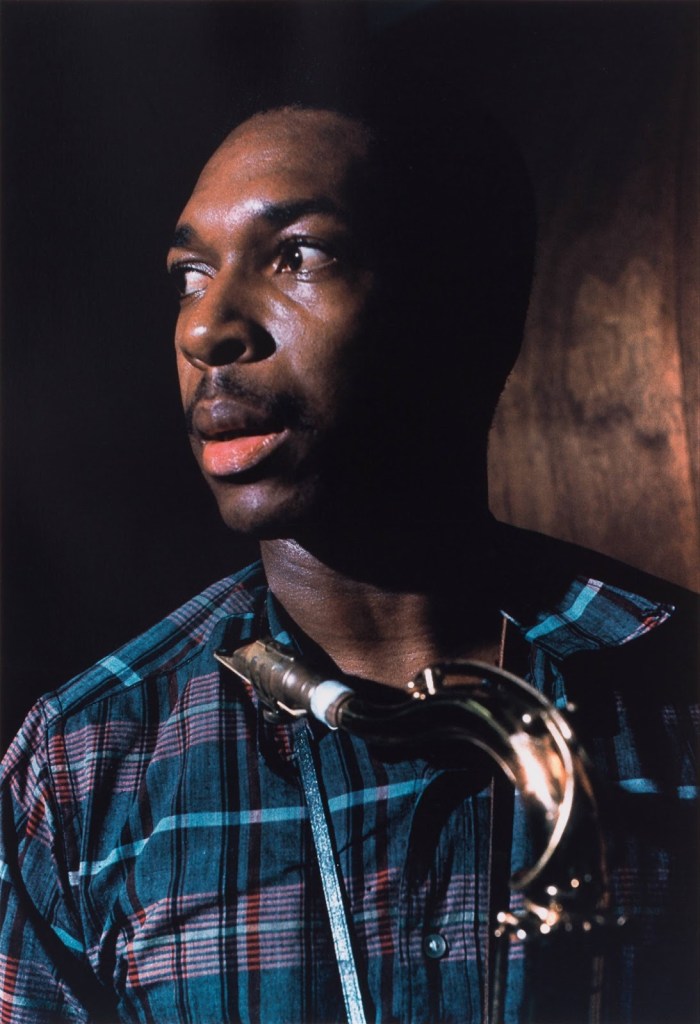
John Coltrane, unusually in colour (1960). Photograph by Lee Friedlander.
The LP (1948) and, slightly later, stereo recording (commercially from 1958) (see Wikipedia, n.d.) gave players like Coltrane time and sonic space to push through expressive limits in both commodifiable and commercially successful form, such as My Favorite Things (1961). Coming down from his heroin addiction in the late 1950s, A Love Supreme (1965) was Coltrane’s wildly ambitious and passionate but accessible paean to the Creator, his own heartfelt version of sixties’ countercultural pan-religionism. Coltrane’s final style before his death from liver cancer was an incendiary ‘free jazz’. Originating with Ornette Coleman, free jazz crossed over with the classical avant-garde (Ross, 2007, pp. 518–520) and the increasing urgency and intensity of the Black struggle for Civil Rights; it explored, in music, the conception and very experience of freedom.
John Coltrane, A Love Supreme, Pt. 1 – Acknowledgement from A Love Supreme, 1965
Coltrane’s funeral July 21, 1967
This is just a sketch of a scene. I hesitate to intrude on private grief. There is a simple order of service.
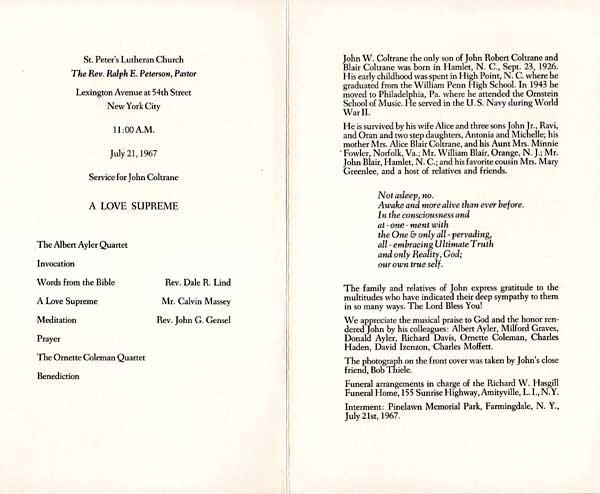
Photo 6 Order of service for Coltrane’s funeral. Photographer unknown.
Coltrane protégé/friend/mentor Albert Ayler and his band play the first tribute; Ornette Coleman plays second. Ayler in full flow is not easy listening.
Albert Ayler Trio, Ghosts: Variation 1 from Spiritual Unity, 1964
‘The music became a way to be both beautiful and angry at the same time,’ [alto sax player Jackie] McLean told the New York Times in 1985. “It wasn’t a choice to be angry … It was a decade of death, and what can a musician do but reflect the times he’s in? Some of the saxophonists you heard—Ayler, Coltrane, Marion Brown—sounded like a ghetto child being beaten”’ (Gavin, 2024). White British photographer and writer Val Wilmer was there in St Peter’s. As she says in her remarkable and loving book about the free jazz scene (Wilmer, 1977), Ayler’s music ‘was a cry’, a return to humankind’s most primitive expressiveness but mediated by the saxophone. At the funeral, in front of 1000 people, Ayler tore the horn from his mouth mid-performance to emit literal cries of anguish and joy (Jenkins, 2004, p. 26). There is no recording, but some of the spirit of Ayler’s Apocalyptic/Pentecostal playing is captured in one amazing photo. Coltrane’s casket is on the left.
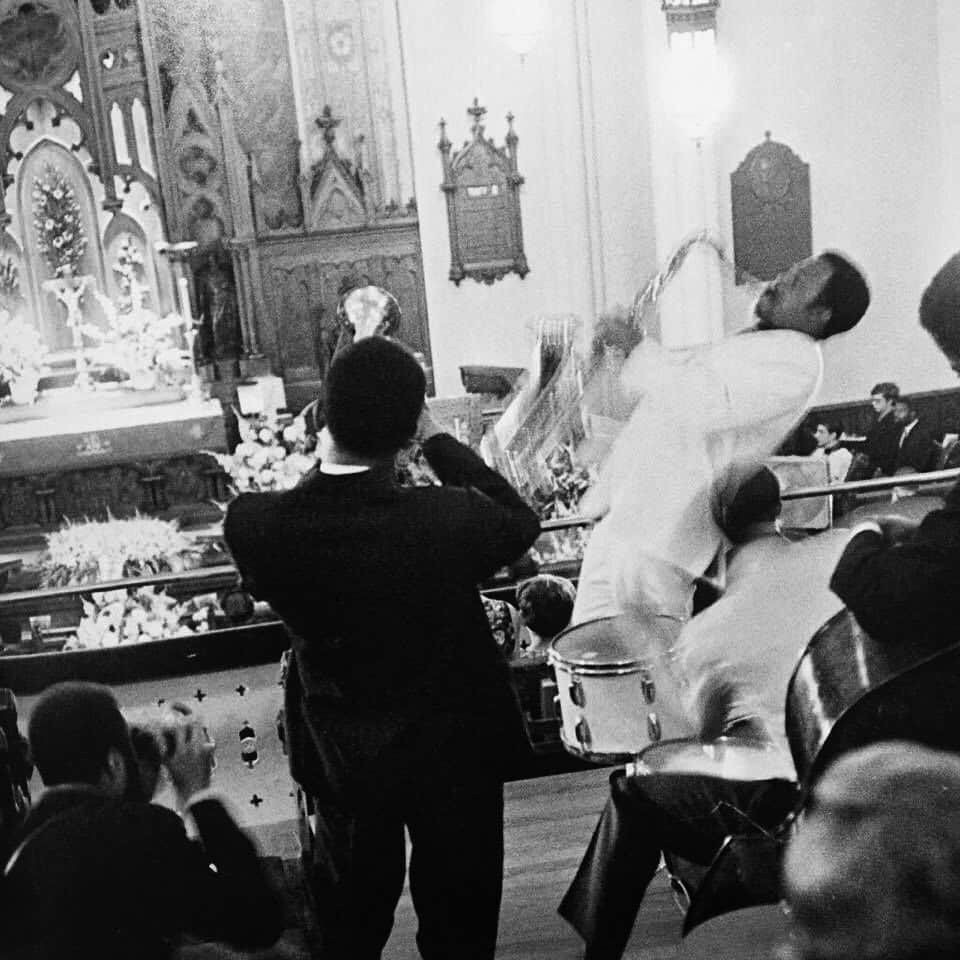
Photo 7 Evanescent angel: Albert Ayler. See Laskey (2017). Photographer unknown.
The rest is silence.
References
Baines, A. (1967). Woodwind instruments and their history (3rd ed.). Faber and Faber.
Beer, S. (1981). Brain of the firm (2nd ed.). Wiley.
Berlioz, H. (1855). Grand traité d’instrumentation et d’orchestration modernes (2nd ed. revised and enlarged). Schonenberger.
Byrne, D. (2012). How music works. Canongate.
Csikszentmihalyi, M. (1990). Flow: The psychology of optimal experience. Harper & Row.
Deleuze, G., & Guattari, F. (1987). A thousand plateaus: Capitalism and schizophrenia. University of Minnesota Press.
Gavin, J. (2024) Inside Slugs’ Saloon, jazz’s most notorious nightclub. Jazz Times. https://www.jazztimes.com/features/profiles/inside-slugs-saloon-jazzs-most-notorious-nightclub/?v=7885444af42e
Gioia, T. (2011). The history of jazz (2nd ed.). Oxford University Press.
Jenkins, T. S. (2004). Free jazz and free Improvisation: An encyclopedia, volume 1. Greenwood Press.
Laskey, K. (2017, July 13). Signifyin(g) with the dead: Musical memorialization at John Coltrane’s funeral. Music & Literature. https://www.musicandliterature.org/features/2017/7/13/signifying-with-the-dead-musical-memorialization-at-john-coltranes-funeral
Marx, K. (1859/1977). A contribution to the critique of political economy. Progress Publishers. (Original work published 1859) https://www.marxists.org/archive/marx/works/1859/critique-pol-economy/preface.htm
Marx, K. (1973). Grundrisse: Foundations of the critique of political economy (rough draft) (M. Nicolaus, Trans.). Penguin. https://www.marxists.org/archive/marx/works/download/pdf/grundrisse.pdf?utm_source=chatgpt.com
Marx, K. (1983). Grundrisse der Kritik der politischen Ökonomie (Rohentwurf). In Marx-Engels-Werke (Vol. 42). Dietz Verlag. (Original work written 1857–1858)
Munrow, D. (1976). Instruments of the Middle Ages and Renaissance. Oxford University Press.
Millard, A. J. (2005). America on record: A history of recorded sound (2nd ed.). Cambridge University Press.
Ross, A. (2007). The rest is noise: Listening to the twentieth century. Fourth Estate.
Sax, A. (c. 1850). Sax Company instrument catalogue. https://commons.wikimedia.org/wiki/File:Adolphe_Sax_instrument_catalogue.jpg
Segell, M. (2005). The devil’s horn: The story of the saxophone, from noisy novelty to king of cool. Farrar, Straus and Giroux.
Slonimsky, N. (1947). Thesaurus of scales and melodic patterns. Charles Scribner’s Sons.
Wikipedia. (n.d.) History of sound recording. Retrieved April 1, 2026, from https://en.wikipedia.org/wiki/History_of_sound_recordingWilmer, V. (1977). As serious as your life: The story of the new jazz. Serpent’s Tail.
 Making a Zine
