Musical Spandrels
Thesis: Technical innovations in music are driven by cultural demand for better expression of collective sentiments. Changes in technology are developed to provide this but the openings they make lead to unforeseen consequences – analogous to the evolutionary phenomenon of spandrels. Culture and technology function recursively, one influencing another. Technology is a revealing (Heidegger) of a distributive culture’s possibilities (Glăveanu / Deleuze) that reshapes it and its subjects (Marx).
Introduction
Technology is the enemy of art. The idea that technological innovation, or the dominance of technical over aesthetic thought, devalues art is common enough. Today the moral panic of “AI sloppification” is constantly circulating about our feeds – or at least this author’s. The shift in material relation to creativity, that I can conceivably get AI to simulate my vision rather than have to produce it “by hand”, has led to a significant loss of quality. The production of AI art functions as a verb on art as a whole. Art itself is “sloppified”:
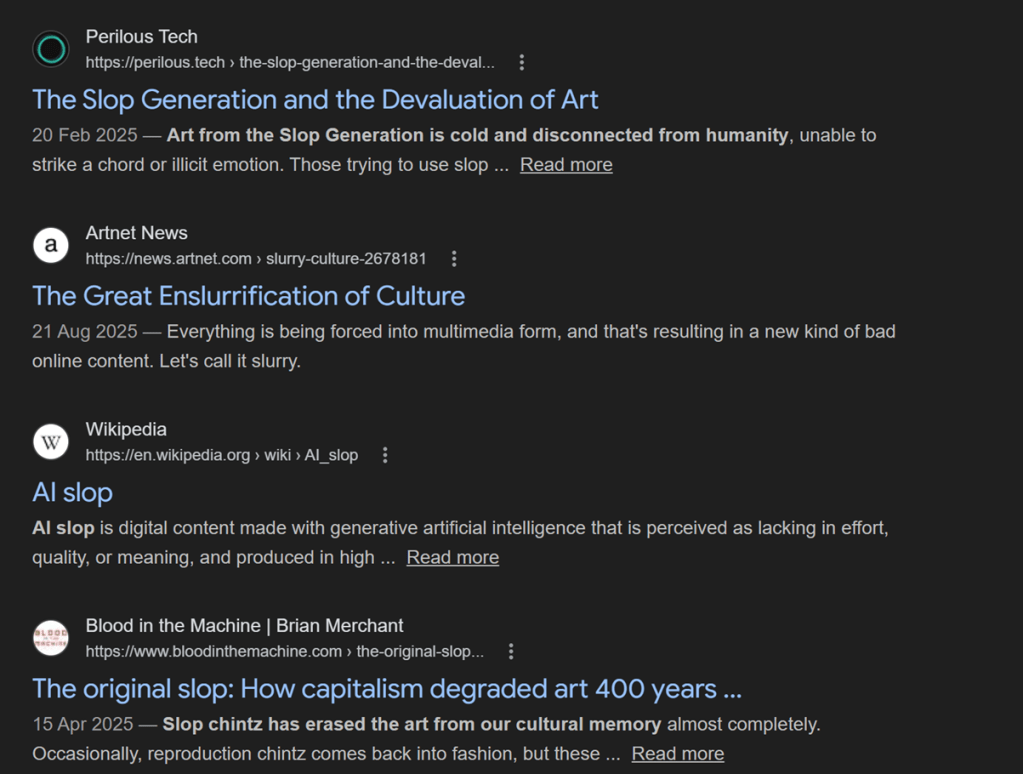
This idea is both older than we would expect and particularly modern. Two authors, both of the same generation and citizenship though opposite political polarities, are the genesis: Benjamin and Heidegger.
Benjamin: Technology Reduces and Redistributes
Benjamin’s major work is Art in the Age of Mechanical Reproduction and is unique in being the seminal attempt to qualify aesthetic value in view of the means of artistic production. It assumes a labour theory of value of art wherein the original article itself, say a painting, is imbued with an “aura” of authenticity. This is the thing the artist made and its value shines through from the effort they put into it – both time and thought. Mass reproduction does not merely produce lesser versions of the original but reduces its aura. For every picture we make of the Mona Lisa, the original becomes lesser. The veracity of Benjamin’s statement is unimportant. All that matters is we see some sense in this, as evident that Benjamin’s larger reputation tends to orbit around this single essay. Benjamin’s small shred of optimism is that the spread of technology will remove barrier of artistic production for the proletariat. Art may be devalued but it will be democratised. (Benjamin, 1935)
Heidegger: Art Reveals and Technology Discloses
Famous non-democrat, Heidegger takes a far gloomier position. In The Question Concerning Technology Europe’s favourite member of the petit bourgeoisie distinguishes modern technology from poesis. In his famous “turn” Heidegger found a preference for the poetic mode and went so far as to declare this form of relation as the disclosure of being. This was found most readily in the work of art, most often German Romantic poetry, in fellow essay in his later period The Origin of the Work of Art. Technology on the other hand, more specifically technology less analogue than that of a spade, distances us from being. The focus in Heidegger’s work is the impersonal nature of more complex technology. In his wider phenomenology the being of humanity is defined more or less by how we relate to our immediate surroundings. The less “to-hand” my engagement is the more the use of it distances me. This essay appeared in the same year as the first commercial transistor radio was released. We can scarcely imagine his response to Claude. (Heidegger, 1971; Heidegger, 1977)
A Pessimistic View – Democratic Art as Doomed
Views on the impact of technology on the quality of human experience today can be split into a binary. One is Heideggerian, as detailed before, while the other is Promethean. The Promethean worldview is one of late Hegelian wherein human nature is the development of reason that is actualised by work. As recently as 2018 Reza Negarestani published a book called Intelligence and Spirit which argues human reason as a project to instantiate ourselves in the world with AI being the latest development of this. (Negarestani, 2018) A darker angle is the early work of Nick Land, who sees humanity as an instrument for creating AI. (Land, 2018) Both are currently published and for sale by Urbanomic press, despite Land’s (perhaps unsurprising) explicit turn to the alt-right. At its best the Promethean is an enduring hangover of Hegelian optimism that fails to take the dangers and limits of technology seriously. At its worst it is a disturbing anti-humanism that continues, irresponsibly, to fester amongst the intellectual vogue.
It seems either technology is a great impasse to the true value of art that must be discarded to salvage the human spirit, or this spirit is only valuable to the demands of technology. Such exaggerated panic is a common enough feature in an age of signalled extremities of opinion and placation in activity.
We occupy neither a Promethean nor a Heideggerian view. We consider the current moment of “sloppification” to be a confusion in the use of new technology rather than a revelation of the technology being essentially corrosive to artistic production. The other pages of this zine have attempted, through demonstration, to emphasise how the development of new styles / forms in art, specifically music, is intimately connected with its technologies – in our cases the history of an instrument’s design.
Marx: Means of Production as Determinate of Consciousness
Both Benjamin and Heidegger’s views are centred on the individual’s experience of aesthetic value, one that is reduced via mass technology. While the Promethean view takes a more collective perspective, the transformation of humanity as a whole, it clearly is less interesting in empowering them than it is exploiting them for its own ends. Is there a view where collective action is active rather than responsive?
Marx argues that human consciousness is determined by the means of production. The social division of society into workers and owners produces a “class” of people which is to say a group that occupies a similar mode of consciousness. The bedrock of his materialist history is that history itself, the story of people and their acts, is determined by their material conditions. This material world is not nature, but economy which is transformed into such by labour. (Marx, 1859) Marx was the first to identify the recursive nature we have with our technology, in his day taken to be “the means of production”, which reflects the McLuhan quote we put at the beginning of this zine: “We shape our tools and thereafter our tools shape us.” (McLuhan, 1964)
Technology is a collective action, one while held in the hands of a small elite will not reach its fullest potential – hence the need for the redistribution of wealth and horizontal structures of power. But does this not spit in the face of the nature of the artist? The individual working at the edges of society? How is “making AI work for us” benefit the artist?
Glăveanu / Deleuze: Social Demand and the Possible
Glăveanu, in Distributed Creativity, takes a view that creativity is not the work of a singular genius working either benefitted or hindered by a faceless mass but an activity of the social. [Glăveanu, 2014] At the end of one of his chapters he quotes Vygotsky’s dissertation on art which summarises his own sentiment: ‘Art is the social within us, and even if its action is performed by a single individual, it does not mean that its essence is individual … This is why the action of art … is a social action’ (Vygotsky, 1971, p. 249). This ties in well with Marx’s concept of consciousness itself being determined by our material relations. The individual is part of the fabric of the social, their creativity a facet of that. Yet how does a change in technology seem to change so drastically the entirety of that fabric. It is here we turn to the rhizomatic thinking of Deleuze.
In the last years of his life, though also as a current through the breadth of it, Deleuze was developing a concept of “the Virtual”. Taking an empiricist position where concepts are nominative categories applied to reality, rather than discoveries of how reality functions by the laws of reason, a larger degree of freedom is allowed. What allows the creation of new concepts, which reveals new potential, is the cultivation of desire by non-hierarchical thinking, namely: rhizomatic thinking. Reality is “the Virtual” in that it is unrealised potential in which philosophy can access new reifications. In looking squarely to the past, to prior forms of creativity, we only see how potential has been realised. We cannot predict the use of new technologies by inspecting the known use of others. (Deleuze, 1964/1994)
Yet what we have tried to demonstrate through our works is the remarkable way changes in technology affect a wider change in aesthetic sensibility itself. When the reed was added to the saxophone no one could have expected jazz, same with the piano and impressionism nor the Kaban’s synthesis with the poetic culture of Somalia into a political symbol of cultural belonging. We believe this demonstrates that technological innovation functions rhizomatically, coming from anywhere but the tops of imagined hierarchies, to action a previously unimagined potential in the virtual. What we see is how the distributed creativity of a social scene through a technological change is able to reveal a potential not before imagined. We name these changes spandrels.
The Virtual Spandrel – Immanence
A spandrel is an incidental byproduct of evolution. Something that develops for a different purpose that is either functionally useless or taken on actively. Biological examples include the human chin. Cultural examples, controversially, include language and music. The idea here is that while we can imagine an immediate, practical use to things like language we can’t believe that it developed retroactively by a biological impulse to create poetry. To put it plainly, something can be made for one reason then turn out to be very useful for another.
We believe we have demonstrated across our three essays how the changes in instruments have functioned in this manner. The spandrel functions as a tool to unlock potential that reshapes the cultures it finds itself in. The scenes we have discussed have their big names, yet they are situated in wider cultural shifts. There is no Chopin without the pedal, there is no Coltrane without the reed and who can imagine Somalian music without Hudeidi but where is Hudeidi without his Kaban? The very potential to become the musicians these people were was effected by a technological shift that took place in a wider cultural context. All our pieces have attempted to demonstrate this by careful attention to the wider political and cultural movements they lived within. They worked within a collective consciousness that determined them just as they would determine it.
Conclusion
Works have been penned recently complaining about the desire for immediacy such as in Anna Kornbluh’s Immediacy, or The Style of Too Late Capitalism. It similarly targets the works of popular, or “low”, culture such as “television” – though all the kids are now on TikTok. There is a snobbery implicit in technology that reduces barriers for creativity and the infantile use of a nascent technology by the non-institutionally educated makes an easy target from the two people in the world with the time and money to understand the nuances of early Proust. The 19th century has suffered a long and slow death at the hands of 20th century popular culture. The great genius has disappeared from the parlours and popped up at the grammy’s.
There is often a delay between a technological innovation and its proper use. The potential of the saxophone was not utilised in orchestra but jazz. The printing press led to an outpouring of small press disposable pamphlets before ensuring the cultural phenomenon of popular novels. AI art is, currently, crap. It is used with fervent excitement of its potential without really knowing that that potential is. The criterion of judgement, the tasteful use of AI, is still missing. This will only come with time.
A technology responds to a cultural demand, one dimly articulated. The innovation opens up possibilities that we engage with crudely. The sloppification of art results from the excitement with the tool that we are unfamiliar with how best to use. Positions of hysteria from both sides fail to admit that while the “how” question of artistic creativity’s relation to technology can be explained the “why” is still imperceptible. Where the intuition to take a byproduct of a technology and develop it to a potential unforeseen at creation comes from still to be decided.
Whatever the new subjectivity that may utilise the technology of the future will be the one willing to be changed by it. The only way out is through.
Bibliography
- Benjamin, W. (1935). The work of art in the age of mechanical reproduction. (J. A. Underwood, Trans.). Penguin Books. (Original work published 1935)
- Deleuze, G. (1994). Difference and repetition (P. Patton, Trans.). Columbia University Press. (Original work published 1968)
- Glăveanu, V. P. (2014). Distributed creativity: Thinking outside the box of the creative individual. Springer.
- Heidegger, M. (1977). The question concerning technology and other essays (W. Lovitt, Trans.). Harper & Row. (Original work published 1954)
- Heidegger, M. (1971). The origin of the work of art. In A. Hofstadter (Trans.), Poetry, language, thought (pp. 15–86). Harper & Row. (Original work published 1950)
- Kornbluh, A. (2024). Immediacy, or the style of too late capitalism. Verso.
- Land, N. (2018). Fanged noumena: Collected writings 1987–2007. Urbanomic.
- Marx, K. (1859). A contribution to the critique of political economy (S. W. Ryazanskaya, Trans.). Progress Publishers.
- McLuhan, M. (1964). Understanding media: The extensions of man. McGraw-Hill.
- Negarestani, R. (2018). Intelligence and spirit. Urbanomic/Sequence Press.
- Vygotsky, L. S. (1971). The psychology of art. The MIT Press.
 Making a Zine