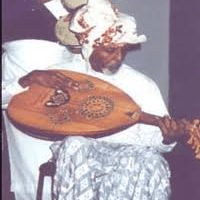
In memory of Abdullahi Qarshe (1924-1994), who integrated Oud to Somali music
Oud, later renamed ‘Kaban’ in Somali music, is a fretless, short-necked lute. Its constructed that shapes sound and expressive capacity (Touma, 1996; Wright, 1978). Primarily built from wood. The term ud is derived from the Arabic word al-ud, the “wood” (Ungvarsky, 2023). It’s a thin-soundboard guitar with a round-body carving and rosettes, which allows continuous pitch variation and supports microtonal expression, a central feature of a modal system such as maqam, making it unique (The Oud, n.d.; Touma,1996).
According to Mizrahi (2023), timber is a key auditory quality that distinguishes the sound pitch and loudness. The case of the oud bowl-shaped body gives it a distinctive resonant tone, which sounds vibrated and voice-like within a hollow structure, producing an expressive tone when played close to the body as the sound is shaped through direct physical interaction between the performer and the instrument (MaqamWorld, n.d., Encyclopaedia Britannica, n.d).
Originating in medieval Persia, notably the Barbat in the seventh century. Oud was later integrated into traditional Arabian and North African music. Over time, the oud gained popularity, and it became a central instrument not only in art and music but also as a symbol of cultural expression. Its quick adaptability allowed it to integrate a variety of oral poetic cultures and narrative forms, facilitating cross-cultural exchange and influenced other regional instruments.
Oud is renamed Kaban in Somali music, and it’s now valued not only as a musical instrument but also as an integral part of cultural significance. It supports poetic performances that enable subtle tonal inflexion reflecting the emotional depth and rhythm of the oral tradition. Through its prominent presence in Somali music, the oud has increasingly attracted in delivering gabay (poetry reading) and storytelling. Kaban is now recognised as both a musical instrument and a symbol of Somali heritage and identity (Farmer, 1967; Write, 1978; Touma, 1996).
Today, the oud does not belong to one nation; it is a shared musical heritage across West Asia, North Africa and the Arabian Peninsula. Oud is closely linked to the codification of maqamat or melodic modes (Touma, 1996; Racy, 2003). In the Islamic world, the Oud attained exceptional cultural prestige. Earlier scholars noted that the Persian lute tuning was adopted for the oud, which later became the classical Arabian instrument. The melodies and rhymes were composed within a model system that was later codified (Write, 1978; Farmer, 1967).
Al-Farabi is often recognised as one of the most influential music theorists of the Islamic Golden Age. In his kitab al-Musiqa al-Kabir (Great Book of Music), he framed music as both a theoretical and a practical science, grounded in human sensory expression and emotional perception (Mihaylov, 2025). Al-Farabi’s work acknowledges the “definition of melody” and the origins of music (Al-Farabi, 10th century/1968; Mihaylov, 2025)
Within this tradition, the concept of tarab illustrated the effective power of music. Racy (2023) explains that the tarab refers to “a state of heightened emotions or ecstasy” shared between performer and audience. Its not purely individual but a collective production through intersections and listening. Tarab is described as a form of “sonic affect” that emphasises its embodied, immersive and socially co-created nature (Al-Farabi, 10th century/1968; Mihaylov, 2025).
Oud was introduced to Somalia through its longstanding trade and cultural exchange. Hussein (2023) noted that the immigration of the oud echoes a wider pattern of cultural exchange that reflects complex African-Arabian-Mediterranean cultural crossroads. Rather than being imported, oud was re-signified within Somali culture, where it was renamed the kaban. Oud is now embedded within poetic traditions and musical forms, such as (heello or heeso) or songs and later qaraami (Classical music). A 2025 article published in Dhaxalreeb described the kaban’s entry from ‘Yamen to Zailac’ , the coastal city of Somalia, although this claim remains debated. However, there is no disagreement that oud reshaped Qaraami sound into new forms. This transformation recalls what Appadurai calls ‘social life of things’: objects acquire new meanings as they move across cultural contexts (Appadurai, 1986). Kaban is not only a borrowed instrument in Somali music; it is the medium through which oral-poetic culture entered a new sonic structure. in this sense, kaban is not external to the culture, but one of the technologies that emerged through mich modernity in music, met with the ancient oral-poetic
Abdullahi Qarshe (1924–1994) was one of the key figures in integrating the oud into Somali music, locally known as ‘kaban’. Born in Tanzania, his life was shaped by migration and diasporic experience, which exposed him to the culture of the oud. Qarshe composed numerous works, most notably the Somali National anthem and the Price Lumumba song. He used qarami music and poetry as powerful, expressive tools for anti-colonial resistance to promote independence and national unity, which extended into a wider pan-African consciousness. The kaban helped promote heello or songs, making them accessible to wider audiences through radio and theatre performances, communication that reached beyond literacy barriers.
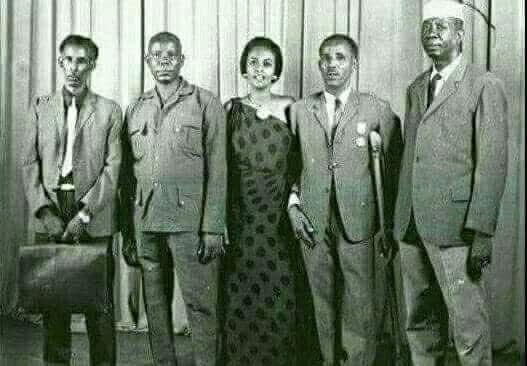
Early Somalian Music Group who played a role introducing the kaban into Somalia. Early 1970s: From the left Xuseen Aw Faarax, Qaasim Hillawle, Khadiija C Dalays, Cabdilaahi Qarshe Iyo Xuseen Baajuuni.
Lumumba Mourning Song
Another key figure in qarami music was Ahmed Ismail Hussein (1928-2020), known as Hudeidi, and often referred to as the ‘king of oud’.
His exceptional mastery of the kaban elevated Somali cultural music both in the diaspora and at home. Hudeidi played a key role in shaping Somali music and art heritage in the UK and in the diaspora. Living in London, UK, for over four decades, he dedicated himself to teaching kaban and mentoring generations of musicians, artists, and cultural practitioners, both in diaspora and back home. Hudeidi thereby became a central pillar of the cultural scene.
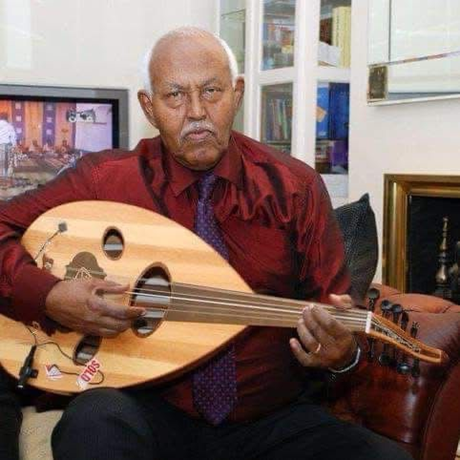
Hudeidi in London before he passed away
Hudeidi’s Somalian TV Interview
“(Uur Hooyo) Mother’s Womb” Sung by: Jiim Sheikh Mumin (1945-2021)
The presence of kaban is another layer to the diasporic experiences. Recent scholarship argued that through the kaban, poets and melodists ‘reshaped and redefined’ Somali sound into songs, helping drive the transformation of oral poetry into modern sung forms such as heello and qarami. Also, how migration can facilitate cultural fusion goes beyond borders and profoundly influences musical practice in the diaspora. In this sense, the kaban is not merely an imported sound-producing item but has become an integral part of the cultural technology through which modern musical expression emerged and through which memory and belonging continue to be voiced in diaspora.
In Somali, the kaban became a key medium through which poetry culture moved into song, and in which longing, intimacy and collective memory could be voiced across diaspora and homeland. The kaban helped transform recited poetic verses into melodically structured performance produce, repeatable songs rather than purely situational oral utterance and ultimately helped create a recognisable qarami’s popular music tradition.
Abdullahi Qarshe and Ahmed Ismail Hussein (Hudeidi) collectively foregrounded the kaban (oud) as central to this transformation of Somali music. Qarshe’s role in qarami and the popularisation of heello positioned the kaban within Somali music, whereas Hudeidi’s artistry mastered the kaban, shaping the emotional and technical. Together, their contributions shaped qarami music and consolidated the kaban as a symbol of Somali music identity across homeland and diaspora image
In diaspora, the kaban stands for the complexity of migration, poetic memory and cultural continuity. Its both old and mobile, both inherited and remade. Its history runs from the Islamic Golden Age to London and into contemporary cultural identity and diaspora.
The Kaban as Cultural Infrastructure
The kaban is not just an instrument, it has become a cultural infrastructure that:
- connects past and present
- mediates between individual and collective identity
- translates into cultural belonging.
In this sense, the kaban is a scene in itself: a dynamic, relational system through which Somali diaspora communities feel, remember and recreate home.
Nuradin Ali Mumin playing Ahmed Jaango’s song, composed by Hasan Ganey
Hudedi honouring one of his guitars to his student (Suldan Ali Shire)
The kaban as a mediating system:
| Agent | Mittelbar (Medium) | Receptor | Context |
| Music | Oud | Islamic World → Somalia | Identity |
| Somali Musician | (Oud) renamed Kaban | Diaspora | Memory, Longing, Identity |
| Oral Poet | Melody + rhythm | Audience | Transition Oral →music |
| Migration subject | Sound | Self/collective | Sense of belonging |
In this context, the kaban does not simply produce sound; it produces a scene, a configuration of affect, memory and collective recognition. The sound of the kaban can collapse distance, bringing together fragmented identities across time and space. This resonates with Stuart Hall’s notion of diaspora identity as something ‘becoming’ rather than ‘being’, constantly produced through cultural practices rather than fixed origins.
From poetry to song: re-mediating voice
Before the widespread use of instruments, Somali culture was and remains deeply rooted in oral poetry. The introduction of the kaban enabled a shift:
From recited poetry → melodic composition
From individual voice → collective listening
From text → embodied performance
This transformation was not merely aesthetic; it was epistemological. Knowledge, emotion and social commentary became musically mediated.
In diaspora, the kaban acquires an additional layer of meaning: it becomes a technology of nostalgia.
- The sound of the kaban often accompanies the following:
- Cultural festivals and remembrance events
- Digital circulation (social media)
The instrument mediates what we might call ‘affective continuity’, a way of maintaining connection to the homeland despite the distance. Drawing on Paul Gilroy’s concept of the Black Atlantic, we can understand the kaban as part of a transnational sonic network, where identity is produced through movement, hybridity and circulation.
References
Abdi, C. M. (2015). Elusive Jannah: The Somali diaspora and a borderless Muslim identity. University of Minnesota Press.
Abdullahi, M. D. (2001). Culture and customs of Somalia. Greenwood Press.
Adileh, M. (2011). Arabic music between the hammer of technological modernity and the anvil of legacy. Journal of Arabic Literature, 42(2–3), 325–349.
Al-Fārābī. (10th century/1990). Kitāb al-Mūsīqā al-Kabīr (The Great Book of Music) (translated editions). (Classical work)
Al-Farabi. (1968). Kitāb al-Mūsīqā al-Kabīr (The great book of music) (M. al-Hafni, Ed.). Dar al-Kutub. (Original work published 10th century) Available at: https://archive.org
Appadurai, A. (1986). The social life of things: Commodities in cultural perspective. Cambridge University Press.
Bordelon, C. A. (2012). Finding the feeling through movement, music and memory: Oriental dance, tarab, and Umm Kulthūm. Congress on Research in Dance Conference Proceedings, 44, 20–29.
Dahir, F. J. (2025). The making of Hudeidi: Crafting an icon of Somali qaraami music. Dhaxalreeb, 21(1), 113–120.
Encyclopaedia Britannica. (n.d.). Islamic arts: The history of Islamic music.
Encyclopaedia Britannica. (n.d.). Islamic music: History and theory.
Encyclopaedia Britannica. (n.d.). Middle Eastern music.
Encyclopaedia Britannica. (n.d.). Oud.
Encyclopaedia Iranica. (n.d.). Fārābī and music theory. https://www.iranicaonline.org/articles/farabi-v
Farmer, H. G. (1967). The Arabian influence on musical theory. Hinrichsen.
Farraj, J. (n.d.). The oud (‘ud). MaqamWorld. https://maqamworld.com/en/instr/oud.php
Gilroy, P. (1993). The Black Atlantic: Modernity and double consciousness. Harvard University Press.
Johnson, J. W. (1996). Heelloy: Modern poetry and songs of the Somalis. Indiana University Press.
Junge, C. (2024). Ṭarab: Sonic affect. PMLA, 139(1).
Kahel, D. (2021). Tarab: A phenomenon of Arab musical culture (Master’s thesis). Uppsala University.
Kapteijns, L. (2001). Laments about labour migration in Somali love songs. Northeast African Studies, 8(3), 33–52.
Kiel, H. (2012). Travel on a song: The roots of Zanzibar taarab. World Literature Today, 86(2), 54–57.
Mihaylov, I. (2025). The great book of music of Al-Farabi: A medieval model for musico-theoretical research. PhilPapers. https://philpapers.org/rec/MIHTGB
Plastow, J. (2020). A history of East African theatre.
Racy, A. J. (1982). Musical aesthetics in present-day Cairo. Asian Music, 13(1), 37–67.
Racy, A. J. (2003). Making music in the Arab world: The culture and artistry of tarab. Cambridge University Press.
Samatar, A. I. (2008). A virtuosic touch: Hodeide, a life with the oud and more. Bildhaan: An International Journal of Somali Studies, 8, 31–51.
Shannon, J. H. (2003). Sultans of spin: Syrian sacred music on the world stage. American Anthropologist, 105(2), 266–277.
Shiloah, A. (2010). Music. In R. Irwin (Ed.), The New Cambridge History of Islam: Volume 4: Islamic cultures and societies to the end of the eighteenth century (pp. 415–442). Cambridge University Press.
Touma, H. H. (1996). The music of the Arabs. Amadeus Press.
Ungvarsky, J. (2023). Ūd (instrument). EBSCO Research Starters. https://www.ebsco.com/research-starters/music/ud-instrument
Woolner, C. J. (2021). Reflections of an oud apprentice in Somaliland. (Conference paper / ethnographic reflection)
Wright, O. (1978). The modal system of Arab and Persian music A.D. 1250–1300. Oxford University Press.
 Making a Zine