Kaban
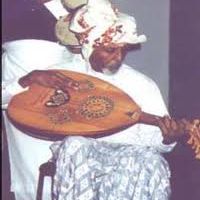
In memory of Abdullahi Qarshe (1924–1994), who introduced the oud to Somali music.
The oud, or ‘cud’, later renamed in Somali music as ‘kaban’, is a fretless, short-necked lute whose material construction directly shapes its sound and expressive capacity (Touma, 1996; Wright, 1978). Built primarily from wood, its name deriving from the Arabic al-ʿūd (‘wood’), it consists of a rounded, ribbed body, a thin soundboard with carved rosettes, and paired strings stretched across a short, unfretted neck (Farmer, 1967; Touma, 1996). The absence of frets allows for continuous pitch variation, enabling microtonal expression central to modal systems such as maqām. Its bowl-shaped body produces a warm, resonant tone with rapid decay, creating an intimate, voice-like quality. Held close to the body, the oud functions as an embodied instrument: sound emerges through touch rather than mechanical mediation. In Somali music, ud or kaban support poetic performance, allowing subtle tonal inflexion to mirror the rhythms and emotional depth of oral tradition.
The oud traces back to medieval Persia, notably the barbat in the seventh century, and was later integrated into the Arabian peninsula, north Africa and the Islamic world, where it became one of the central instruments of art and music. The instrument later took the form now associated with Andalusia and the wider Arab world.
Today, the oud does not belong to one nation; its a shared musical heritage across west Asia, north Africa and the Arabian music history closely linked to the codification of the maqāmāt, or melodic modes (Touma, 1996; Racy, 2003). Within the Islamic world, the oud received exceptional cultural prestige. Earlier scholarship noted that the Persian lute tuning was adopted for the oud, which later became the ‘classical instrument of the Arabs’, and that melodies and rhymes were put together within a model system that was codified (Farmer, 1967; Wright, 1978).
Al-Fārābī is often recognised as one of the most influential music theorists of the Islamic Golden Age. In his Kitab al-Musiqa al-kabir (Great Book of Music), he framed music as both a theoretical and practical science, grounded in human sensory expression and emotional perception (Mihaylov, 2025). His work acknowledges the ‘definition of melody’ and the ‘origin of music’.
Within this tradition, the concept of tarab highlights the affective power of music. As Racy (2003) explains, ṭarab refers to a ‘state of heightened emotion or ecstasy’ shared between performer and audience. It is not purely individual but collectively produced through interaction and listening. More recent scholarship describes ṭarab as a form of ‘sonic affect’, emphasising its embodied, immersive, and socially co-created nature within Arab musical aesthetics.
Through the Red Sea and Indian Ocean routes linking southern Arabia and the Horn of Africa, the oud travelled to Somali coastal cities such as Zeila, Berbera and Mogadishu, long-standing regional networks of trade, diplomacy and cultural exchange. Hussein (2023) noted that the migration of the oud echoes a wider pattern of cultural exchange that reflects complex African-Arabian-Mediterranean cultural crossroads. Rather than being imported, the oud was re-signified within Somali culture, where it became the kaban, embedded within poetic traditions and musical forms such as heelo or heeso or songs and later qaraami (classical music), which became an integral part of Somali music. A 2025 article in Dhaxalreeb describes the kaban’s entry ‘from Yemen to Zeila’ and links it to the reshaping of Somali sound into new song forms. This transformation reflects what Arjun Appadurai calls the ‘social life of things’: objects acquire new meanings as they move across cultural contexts. Today, the kaban is not only a borrowed instrument; it is the medium through which Somali oral-poetic culture entered a new sonic structure. In this sense, the instrument is not external to Somali creativity. It is one of the technologies through which modernity in music was made.
Abdullahi Qarshe (1924–1994) was one of the key figures in integrating uod into Somali music, locally known as “Kaban”. He was often credited with popularising qaraami in the mid-twentieth century, particularly the emerging heelo as a popular song. Born in Tanzania and having lived in Yemen, his life was shaped by migration and diasporic experience exposed to uod. Upon his return to his native country (Somalia), his passion for music and poetic performance led him to recognise the oud’s potential within Somali musical expression. There, he introduced the instrument into performance and the name ‘Kaban’ was born.
Kaban facilitated its cultural translation and found a creative reworking of musical tradition that aligns with Somali poetic rhythm and linguistic aesthetic sensibility.
Qarshe’s music played an important role in Somalia’s anti-colonial movement in the 1950s and, through the transition to independence in 1960, extended into wider Pan-African consciousness. He used qaraami music and poetry as a powerful tool for expressing resistance to independence and national unity. One of his famous songs was his tribute to the mourning of the assassination of Patrice Lumumba, which exemplifies anti-colonial solidarity. The most significant song he composed was the Somali national anthem. Kaban helped create heelo, the songs that made political messages more accessible to wider audiences through theatre performance and radio. Through the oud or kaban, Qarshe used music as a form of political communication that reached beyond literacy barriers.
 Making a Zine